Corner Rounding
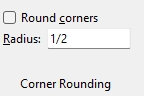
Corner rounding options :
If this box is checked (
), radiused corners as defined by the field Radius will be applied to the most recently located point at the time you left-click ( Locate ) to define the next point. For hatches or fills defined by drawing an area box, Round corners (when checked) applies the Radius to all four corners.
If the box is not checked (
), then pointed corners will be generated. The vertex of the corner will be where you left-click ( Locate ) to define the point.
Radius: A distance that defines the amount of rounding that takes place when the box is checked for Round corners.
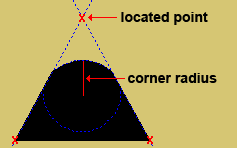
| The corner radius is the radius of a circle. Two lines that are tangent to that circle meet at the located point. The corner's arc ends at the points of tangency of these two lines. |
|
Examples of corner rounding :
|
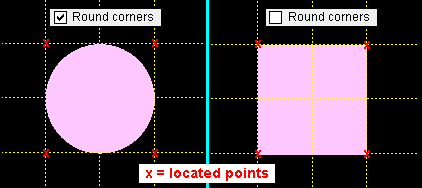
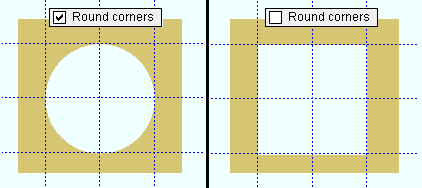
Two fills added using Hatches Add Define Polygon . Corner rounding was turned on for the left example. The radius for each corner was 1/2 the distance of any side of the square, which thus resulted in a circle. |
|
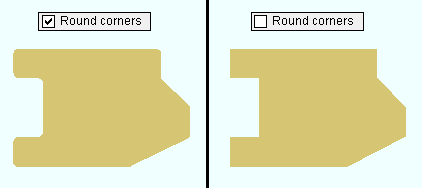
A Flat Plate Layout with corner rounding (left) and without corner rounding (right). |
|
The Cut Layout on the left has four points laid out in a square, but the result is a circle since corner rounding is checked AND the radius for corner rounding is 1/2 the distance of any side of the square. |
|
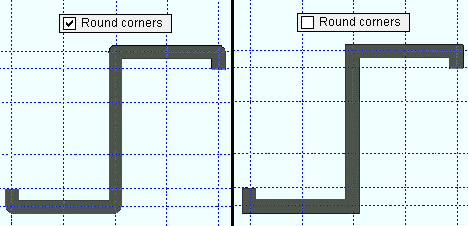
A Bent Plate Layout with corner rounding (left) and without corner rounding (right). |



