 Exporting a U3D file
- General Overview
- Step-By-Step
- Tips and Tricks
- Related Tools
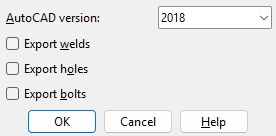
AutoCAD version: Unspecified (sets version to minimum), R10, R11/R12, R13, R14, 2000 - 2002, 2004 - 2006, 2007 - 2009, 2010, 2013, or 2018. This is the export version of the files that are output.
Note: After version R14, Autodesk began to name their versions after the years in which they were released.
Export welds:  or
or  . If this box is checked, welds are output to the IGES file. If this option is not checked, welds will not be output to the file.
Export holes: or . If this box is checked, holes are output to the IGES file. If the box is not checked, holes will not be output to the file.
Export bolts: or . If this box is checked, bolts are output to the IGES file. If the box is not checked, bolts will not be output to the file.
OK (or the Enter key) closes this screen and applies the settings.
Cancel (or the Esc key) closes this screen without saving any changes.
1 . Click the Export Model icon, which is pictured above. The icon can be found on the Import/Export page > Model section.
Method 2: Click Export Model on the home screen. The command can be found on the Export tab in the 3D section. Skip step 2.
Alternative: Use the Find Tool by searching the command name and clicking the Export Model icon, which is pictured above.
Learn more about alternative methods for launching commands.
2 . The status line prompts Select members, and the Select - Pan - Menu mouse bindings become active. Select the member(s), then press Enter or right-click and select OK.
Alternative: Press the Esc key or right-click and select Cancel to end the command.
3 . The Export Model window opens. Select U3D as the Export file format. Set the Destination where you want the file to be sent. Directory outputs the file to a folder. Select Properties to open the U3D Properties window (as shown on the General Overview tab).
4 . Select OK to export the .u3d file.
Alternative: Press the Esc key or select Cancel to end the command.



